

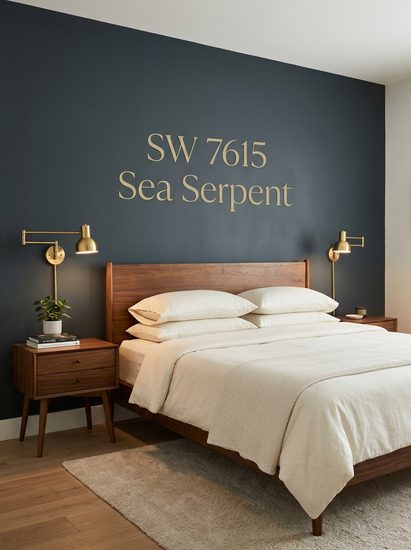
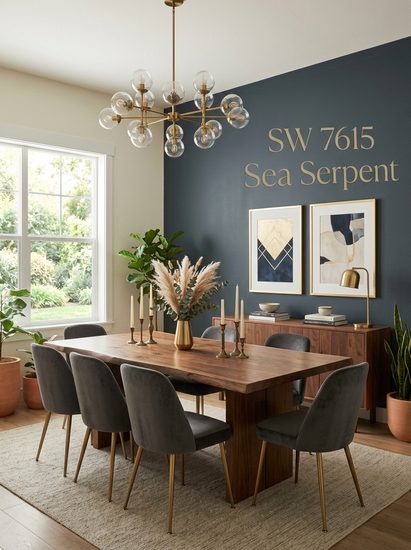
SW 7615 Sea Serpent is a deep, slate-blue paint color that absorbs most of the light hitting it, so it suits bedrooms, dens, and front doors. Use it on one wall or a full room, pair it with warm woods and soft whites, and test a sample first.
Key Takeaways
- Sea Serpent reads as a dark slate blue with a gray cast, closer to stormy water than to true navy.
- Its light reflectance sits near the bottom of the paint scale, so it shrinks a room’s visual edges unless daylight is strong.
- Warm wood, brass hardware, and creamy whites stop the shade from feeling cold.
- Dark paint usually needs three coats, so budget extra paint and a tinted primer.
- Two sample patches checked at three times of day prevent most color regret.
What is SW 7615 Sea Serpent?
SW 7615 Sea Serpent is a dark blue-gray paint color from Sherwin-Williams that blends slate with a faint cool undertone.
How dark is Sea Serpent next to other paint colors?
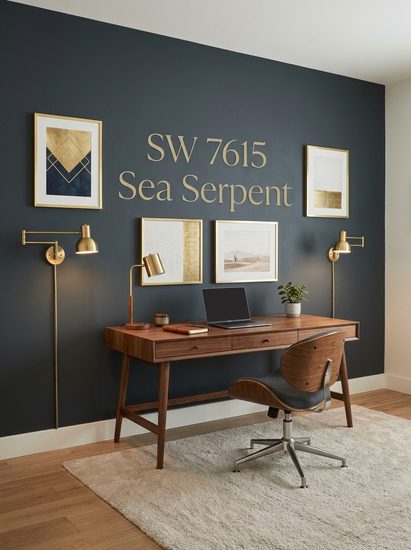
Very dark. It sits in the same light-absorbing bracket as near-black paint.
Light reflectance value (LRV) scores a color from 0 (black) to 100 (white). Four colors side by side show the gap:
| Paint color | Brand | LRV | Source |
| Sea Serpent SW 7615 | Sherwin-Williams | 6.7 | Pontata, Sea Serpent color comparison |
| Boothbay Gray HC-165 | Benjamin Moore | 43.3 | Pontata, Boothbay Gray vs. Sea Serpent |
| Lullaby SW 9136 | Sherwin-Williams | 64.7 | Pontata, Lullaby vs. Sea Serpent |
| Ice Cube SW 6252 | Sherwin-Williams | 77.3 | Pontata, Ice Cube vs. Sea Serpent |
Subtract each LRV from 100 to find the share of light the wall absorbs. Sea Serpent takes in about 93 percent, Boothbay Gray 57 percent, Lullaby 35 percent, and Ice Cube 23 percent. Retail listings round the Sea Serpent figure to 7, while the table keeps the decimal.
That absorption rate changes how you light the room. Place lamps at eye level instead of relying on one ceiling fixture.
Where in a house does a Sea Serpent function best?
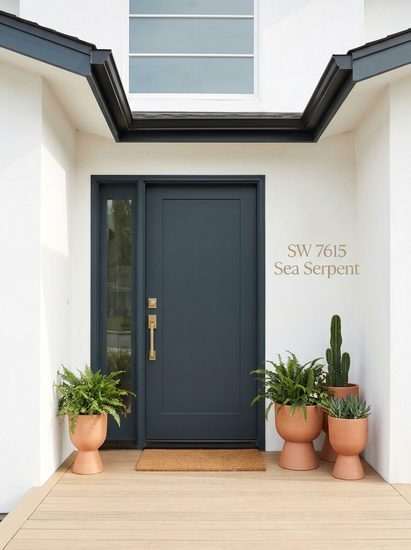
Use it where you want depth and have decent daylight or layered lighting. Skip windowless closets and basements lit by one bare bulb.
- Bedroom: Paint the headboard wall and keep the other three light. In most master suite floor plans, that wall greets you from the doorway, so the dark shade frames the bed like a backdrop.
- Home office: Inside home offices, a matte finish in this shade softens screen glare and makes framed prints pop.
- Den or media room: Dark walls let a TV fade into the background, which suits a designmode24 sporting event watch party where everyone faces the screen.
- Front door and shutters: On pale stucco or white siding, the color delivers crisp contrast. Plant columnar cypress trees near the entry, and their green deepens against the blue-gray.
- Patio or fence: Orange marigolds and red dahlias, two classic mexican flowers, glow against a slate backdrop.
- Terracotta planters: Magenta bougainvillea and other hispanic flowers add heat to the cool wall behind them.
What colors pair well with Sea Serpent?
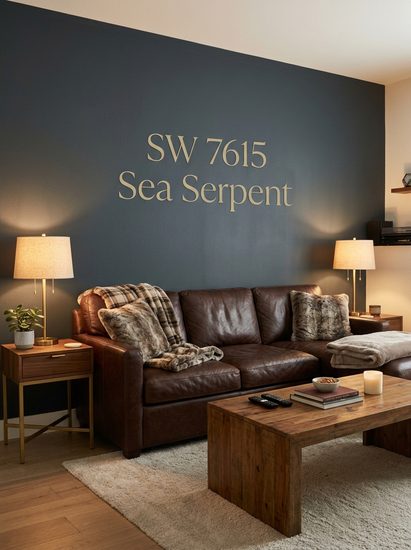
Warm contrast works best. Think creamy trim, oak or walnut, aged brass, and rust or terracotta accents.
- Whites: Choose yellow-based creams for trim. Stark whites look icy beside cool slate.
- Woods and metals: Oak, walnut, and brass bring the warmth the paint lacks.
- Blue comparison: BM Hale Navy leans nautical and saturated. Sea Serpent leans gray and quiet, so pick it when you want calm instead of drama.
According to the Painting & Coating Industry’s September 2025 report, Sherwin-Williams named warm Universal Khaki its 2026 Color of the Year. Paint a khaki-type neutral on the walls beside Sea Serpent, and the dark shade reads as a deliberate accent.
Modern interior design thrives on this kind of contrast: one dark anchor, several warm neutrals.
How much paint does a Sea Serpent room need?
Three gallons cover a 12 by 14 foot bedroom with 8-foot ceilings. Dark colors need three coats, not two.
Product data sheets from Sherwin-Williams rate its premium interior paint at 350 to 400 square feet per gallon. Here is the math for the full bedroom:
- Wall area: 2 × (12 + 14) × 8 = 416 square feet.
- Subtract one door (3 × 7 = 21) and two windows (3 × 5 = 15 each): 416 − 51 = 365 square feet.
- Multiply by three coats: 365 × 3 = 1,095 square feet.
- Divide by coverage: 1,095 ÷ 400 = 2.7 gallons, and 1,095 ÷ 350 = 3.1 gallons.
- Buy three gallons plus one quart for touch-ups.
Run the numbers with designmode24 tools or a phone calculator before you shop. For an accent wall of 14 × 8 feet minus one window, you need only about 97 square feet per coat, so one gallon is plenty.
Is premium paint worth it for a dark color?
Yes. Deep shades hide less per coat, so a richer pigment load pays off.
According to Prudent Reviews’ comparison of Emerald and SuperPaint, interior Emerald runs $85 to $90 per gallon, against $70 to $75 for SuperPaint. On three gallons, the gap adds about $45. A fourth coat costs a full extra evening and another can, so the premium is the cheaper insurance.
Ask the store for a gray-tinted primer first. It gives the first color coat a darker base to build on.
How do you test Sea Serpent before committing?
Paint large samples and judge them in your own light. You can learn very little from a chip the size of a playing card.
- Paint two 2 × 2 foot patches, one beside the window and one in the darkest corner.
- Check both at 8 a.m., 2 p.m., and 8 p.m. under lamplight.
- Hold your trim color and your wood next to the patch.
- Live with it for 48 hours.
The most common mistake is judging the color from a screen. Digital swatches, including any you browse on designmode24.com, only approximate how a dark paint behaves on a real wall. Follow this interior designmode rule: sample on the wall, never on the screen.
Any design designmode checklist for deep colors starts with light, not color. Limit the shade to one or two surfaces per room, a designmode24 design habit that keeps dark spaces from feeling heavy.
One exception breaks the usual advice. In a small room with one north-facing window, three coats of Sea Serpent will not fix the shortage of light, and the walls will read near black by midday. Use a lighter blue-gray there, or restrict Sea Serpent to a door or built-ins. If the light stays confusing after sampling, contact DesignMode24 or a local color consultant before buying gallons.
FAQ
Is SW 7615 Sea Serpent blue or gray?
It is a blue-gray with a slate base and a cool blue undertone. It looks bluer near windows and grayer under dim, warm bulbs.
Can a Sea Serpent work in a small room?
Yes, if the room has a window and layered lighting. Paint the ceiling and trim lighter to keep the space from closing in, or limit the color to one wall.
What sheen suits Sea Serpent best?
Matte or eggshell works best on walls because both hide roller marks and cut glare. Use satin on trim and doors for easy wiping.
Does Sea Serpent work on a house exterior?
Yes, on doors, shutters, and trim. Dark siding in hot climates absorbs more heat and fades faster, so limit full-wall use to shaded elevations.
Which white pairs best with Sea Serpent?
A creamy, yellow-based white pair is best. It warms the cool slate and looks softer than stark white. Test it beside the sample before you buy.
Conclusion
For readers who want depth without pure black, SW 7615 Sea Serpent is a dependable choice. It rewards good lighting, warm contrast, and a patient three-coat job. Sample it, light the room in layers, and this shade anchors a space instead of swallowing it.

