

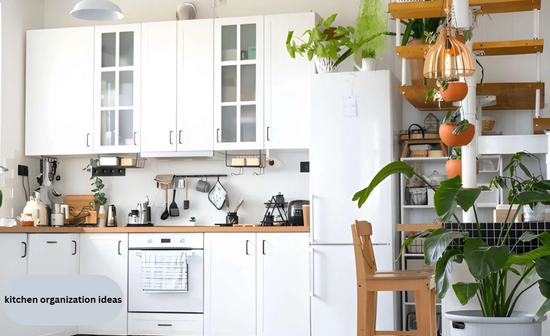
The best kitchen organization ideas start with sorting, not shopping. Empty one zone, keep what you use weekly, and give every item one fixed home near where you use it. Then add dividers, bins, or shelf risers only where a real gap remains. Keep daily items where you can reach them without bending or stretching.
Your counter space changes the answer more than anything else. Whatever interior design style you like, a kitchen works only when you keep some counter clear, so the less you have, the more must move into drawers and cabinets.
Sort one zone at a time into keep, move, and let go

Sort one zone at a time, starting with the drawer or shelf that bothers you most.
- Empty the whole zone onto the counter.
- Group matching items together: bakeware with bakeware, mugs with mugs.
- Let go of duplicates, mismatched lids, and anything you reach past every time.
- Wipe the empty shelf.
- Put items back by how often you use them, with daily things in front.
Duplicates hide in the spots nobody checks, like the high shelf above the fridge or a deep corner cabinet inside home kitchens of any size.
Finish this step before you shop. Kitchen ideas that call for new containers only work when you know what has to be stored.
Zone the kitchen around the sink, stove, and fridge

Store each item within one step of where you first use it. Plates go near the dishwasher, pots near the stove, and food containers near the fridge.
The National Kitchen & Bath Association recommends a prep area at least 36 inches wide and 24 inches deep, directly beside the sink. Keep that stretch free of appliances so a cutting board and a mixing bowl both fit.
The same guidelines ask for 15 inches of landing space beside the fridge handle. Treat it as a drop spot for grocery bags so it never turns into storage.
A tape measure and graph paper are all the design tools tech you need to test a layout on paper first.
If you save inspiration pages as you go, check each link before you rely on it. A stray string such as .www.design in an address makes the page fail to load.
Match kitchen organization ideas to your space and budget

Choose by situation: removable add-ons suit renters, and built-in pull-outs suit owners who plan to stay.
The 2026 U.S. Houzz Kitchen Trends Study found that 76% of surveyed homeowners added specialty built-in features during a renovation. Pantry cabinets were the most common, at 47%.
Those respondents were in the middle of renovating, so the numbers show what renovators choose, not what most households own. You can copy the idea, a set home for every item, with loose bins and dividers instead of new cabinets.
Use this guide to pick your starting point:
- Renting: tension rods, loose drawer dividers, and over-door racks that need no drilling.
- Tiny kitchen: shelf risers and wall rails that use height instead of floor space.
- No pantry: one freestanding shelf or tall cabinet for cans and dry goods.
- Tight budget: jars, shoeboxes, and food containers you already own.
- Best Kitchen Cabinet ideas for owners: pull-out shelves, deep drawer inserts, and corner trays.
Save one photo of a kitchen you like, from a magazine or a designmode24 design page, and copy its logic rather than its exact shelves.
Set up the fridge and pantry so food gets used

Put food where you will see it, and keep it cold enough to stay safe.
The USDA’s Food Safety and Inspection Service advises keeping the refrigerator at 40°F or lower and the freezer at 0°F. To test it, stand a thermometer in a glass of water on a middle shelf and wait 5 to 8 hours before reading it.
Put leftovers and ready-to-eat food at eye level so nobody has to dig for them.
Good kitchen pantry organization starts with a shelf map: daily staples at eye level, bulk items low, and rarely used appliances high.
USDA guidance lists 2 to 5 years of best quality for unopened low-acid canned foods like beans, soup, and most vegetables. Fruit and tomatoes, which are high in acidity, keep for 12 to 18 months.
Shelve tomatoes and fruit at the front and beans and soup behind them, so the shorter clock runs out first.
For a crowd on game day, such as the designmode24 biggest sporting event on your calendar, set up a snack and drink station away from the stove.
Label every shelf and reset after each grocery shop
Plain labels let everyone in the house put things back where they belong.
Masking tape and a marker work fine. Write the category, such as snacks or baking, not a long description.
Reset after each shop: move older items forward and put new ones behind.
Run a quick design designmode check as you reset. If an item has no home, give it one or let it go.
When a shelf still feels off, compare it with reference photos on a site such as DesignMode24 or in a magazine.
Fix the three mistakes that undo a tidy kitchen
Three habits undo a tidy kitchen: buying before sorting, storing by type alone, and packing every shelf full.
- Buying containers before sorting. Fix: measure shelf depth after you sort, then buy only what fills a gap.
- Storing by type alone. Fix: put each item where you first use it, even if that splits a category.
- Packing every shelf full. Fix: leave visible gaps so new groceries have somewhere to land.
The standard process stops working when the room is the problem, such as cabinets too shallow for your plates or an aisle too tight for two cooks. In that case a cabinet fitter or designer should see photos and measurements first. Send both when you contact designmode or any other studio.
Questions people ask before they start tidying
What is the easiest way to organize a kitchen?
Keep only what you use and focus on one zone at a time.. Store each item near where you first use it, then add bins or dividers only for gaps that remain. Finishing a single drawer or shelf before moving on keeps the job small and shows results right away.
How can a kitchen be set up without a pantry?
Include one specific storage item, like a tall cabinet or freestanding shelf.,Then apply it to dry items and cans. Group items in labeled bins by type, with the oldest cans at the front. Keep daily foods in the cupboards closest to the stove and counter.
What temperature should a refrigerator be?
A refrigerator should stay at 40°F or below, and a freezer at 0°F. A thermometer on a middle shelf shows the real temperature, which the control dial does not. After you replenish the shelves, check the reading because the food you add may alter it.
How often should you reorganize your kitchen?
Reorganize a zone when items stop fitting or start piling on the counter, and reset shelves after each grocery shop. No single schedule suits every household, because the right pace depends on how much you cook and buy.
Start tonight with one drawer and one thermometer
The most reliable kitchen organization ideas follow one order: sort first, zone by use, and buy last.. Label each shelf, store food where you can see it, and keep the counter next to the sink uncluttered.Spend money only on the gaps that remain.
- Sort the contents of one drawer or shelf into three categories: keep, move, and let go
- Stand a thermometer in a glass of water in the fridge and read it after 5 to 8 hours.
- Measure the counter beside your sink and clear a stretch 36 inches wide.