

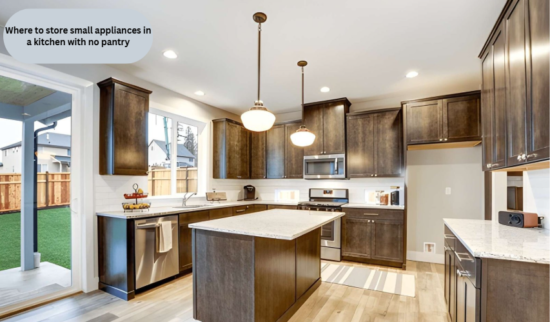
If you’re wondering where to store small appliances in a kitchen with no pantry, you’re not alone. Most US kitchens built before 2010 skipped the walk-in pantry entirely.
That leaves homeowners juggling air fryers, stand mixers, and coffee makers with nowhere obvious to put them. But a missing pantry doesn’t mean cluttered counters forever.
With the right cabinet tricks, vertical space, and a bit of furniture reshuffling, you can fit every appliance you own. No demolition required.
Why No-Pantry Kitchens Struggle
A pantry does one job. It holds bulky, irregular items in one place so they’re not scattered everywhere
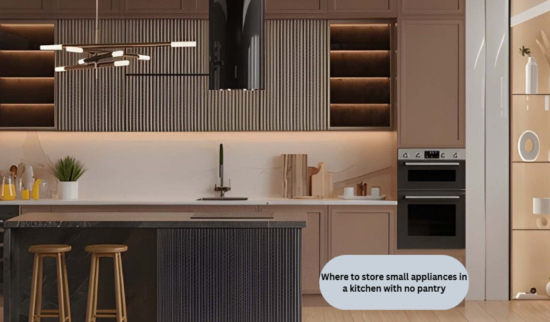
Learn where to store small appliances in a kitchen with no pantry using simple, space-saving ideas.
Without that single zone, your blender ends up on the counter. Your waffle iron lands in a hallway closet. Your slow cooker sits on top of the fridge until Thanksgiving.
The fix is simple: use vertical wall space, deep drawer organizers, rolling carts, and a dedicated appliance garage to free up your counters.
These four moves recover the most usable storage without any construction work.
Claim the Vertical Space First
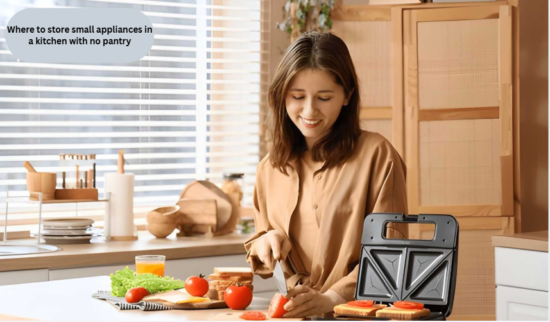
Most no-pantry kitchens waste the gap between upper cabinets and the ceiling. That space, usually six to eighteen inches, is ready for appliances you use less than once a week.
Good candidates for that top shelf:
- Slow cookers
- Ice cream makers
- Panini presses
- Waffle irons used only on weekends
Open shelving works well too. A floating shelf above the counter holds your coffee maker or toaster at eye level. Pick three daily-use appliances for that shelf. Everything else goes elsewhere.
Magnetic strips and wall rails handle smaller tools like hand mixers and immersion blenders. They also keep cords from tangling in a drawer.
A recent kitchen design trends report backs this up. Stud walls are one of the kitchen’s most overlooked storage opportunities because the cavity itself can be used without increasing the room’s footprint, and designers are increasingly recessing shelving directly into non-load-bearing partition walls.
Check with a contractor before drilling into any shared wall. A non-load-bearing wall can sometimes hide two or three extra inches of depth for a slim niche.
Turn Cabinets Into Appliance Zones
| Storage Spot | Best For | Approx. Cost |
| Appliance garage (corner cabinet) | Coffee maker, toaster | $150–$400 |
| Deep drawer with pull-out shelf | Stand mixer, food processor | $80–$250 |
| Pegboard or wall rail | Hand mixer, blender attachments | $30–$90 |
| Rolling bar cart | Air fryer, slow cooker | $60–$200 |
| Over-cabinet bins | Rarely used seasonal appliances | $20–$50 |
An appliance garage is the best fix if you have a dead corner cabinet. It’s a retractable pocket door that hides your coffee maker while keeping it plugged in.
Pocket door appliance garages are a sleek way to hide functional but less attractive items, and designers are increasingly using them to conceal coffee stations and breakfast bars.
A carpenter can usually retrofit one for a few hundred dollars. Far cheaper than a remodel.
Use Deep Drawers and Toe-Kick Space
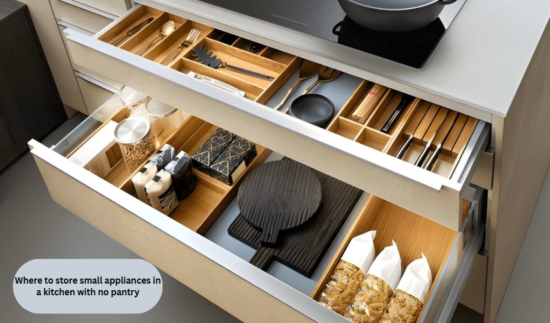
Deep drawers do double duty with a pull-out shelf insert. A stand mixer is heavy and awkward to lift from a low cabinet every time you bake.
A drawer with a riser shelf lets you slide the mixer up to counter height. Use it. Slide it back down. No lifting, no shoulder strain.
Galley kitchens should not skip toe-kick drawers. These sit below your lower cabinets, in a gap that’s almost always empty.The designmode24 design approach leans on the same zone-based thinking covered above, not expensive built-ins.
They work best for:
- Griddles
- Waffle irons
- Baking sheets
- Flat trays
Bring in Furniture That Wasn’t Built for Kitchens
A bar cart, usually sold for drinks, works just as well for appliances. Wheels mean you roll it out when you need the air fryer and tuck it away when you don’t.
A narrow bakers rack against an empty wall does the same job with more vertical levels. Three or four shelves can hold a microwave and a couple of appliances in roughly two feet by one foot of space.
This same thinking applies outside the kitchen too. Anyone figuring out how to layout a narrow 10×12 living room on a budget uses the same trick: break the room into zones, lean on vertical storage, and let furniture do more than one job.
A freestanding pantry cabinet is the closest thing to buying back the pantry you never had. Prices run:
- $150 for basic particle-board units
- $300–$400 for mid-range options with adjustable shelving
- $600 for solid wood versions
Most slide into a gap as small as 18 inches wide.
The Numbers Behind the Clutter
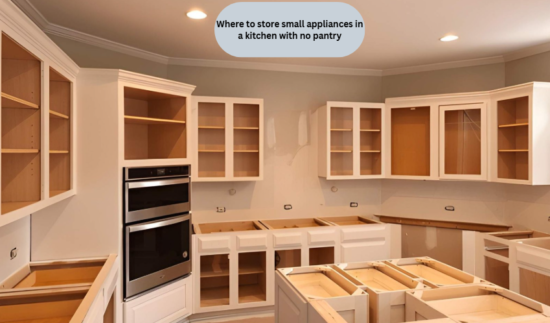
Small kitchen appliances aren’t a passing trend. The global small kitchen appliances market was estimated at USD 39.55 billion in 2025 and is projected to keep growing through 2033.
More than half of urban households have recently upgraded their appliances, and roughly half of those adopted multifunctional units specifically to handle compact kitchen space.
You’re not imagining the clutter. More people own more appliances than five years ago.
That’s also why 2026 kitchen design leans on hidden storage. Designers are now using deep drawers under banquette seating and hidden appliance garages to handle the same overflow problem.
My Pro Tip Nobody Else Mentions
Label the inside of your appliance garage door with a small dry-erase tag. Write down what’s stored behind it and the last-used date.You can browse examples at www. designmode24. com . com before buying any organizers.
After two months, anything still unused gets donated or sold. This habit controls long-term clutter better than any cabinet purchase.
A Designer Worth Checking Out
If you want a second opinion on your specific layout, interior design designmode24 is worth a look. Their team handles exactly this kind of puzzle, fitting full appliance collections into kitchens with zero pantry space.
Where should I put small appliances if I have no pantry?
Use vertical wall space, deep drawer organizers, an appliance garage, or a rolling cart. Pick the spot based on how often you use each appliance.
What is an appliance garage in kitchen design?
It is a retractable pocket door built into a corner cabinet. It hides appliances like coffee makers or toasters while keeping them plugged in and ready to use.
How much does an appliance garage cost?
Most appliance garage retrofits run between $150 and $400, depending on the cabinet size and the carpenter’s rates.
Can I store a stand mixer in a drawer?
Yes. A deep drawer with a pull-out riser shelf lifts the mixer to counter height so you don’t have to lift it out of a low cabinet every time you bake.
Is a freestanding pantry cabinet a good option for small kitchens?
Yes, especially if you have an 18-inch gap to spare. Prices range from $150 for basic particle-board units to $600 for solid wood versions with adjustable shelving.
What to Do Next
Start with one zone, not all five. Pick the loudest problem in your kitchen right now.
- Counter clutter? Install one floating shelf this weekend.
- Dead corner cabinet? Price out an appliance garage retrofit.
- No drawer space? Add a pull-out riser shelf first.
You don’t need a full renovation to solve where to store small appliances in a kitchen with no pantry. You need a few fixes that match how you actually cook. Pick one this week and see how much space you get back.
