
Walk into any worship space, and something happens before the music starts and before anyone steps behind a pulpit or reading table. You feel it. Maybe it is a quiet sense of reverence. Maybe it is warm and welcome. Maybe, in spaces where the seating is worn, the aisles are cramped, or the layout seems to have been assembled without much intention, you feel a subtle unease you cannot quite name.
That feeling is not accidental. It is a direct response to the sanctuary furniture surrounding you, and it communicates something about the congregation that calls this space home.
This is not a small thing. For a first-time visitor, the physical environment of a worship space often registers before the community does. For longtime members, it shapes the quality of their attention week after week. And for the building committees and facilities leaders who make decisions about furniture, this reality carries real weight.
Furniture Is Part of Your Congregation’s First Impression
There is a concept in retail and hospitality design called “environmental storytelling,” the idea that a physical space communicates a narrative without anyone saying a word. Walk into a high-end hotel lobby, and the furnishings tell you immediately whether you are in a place that values comfort, luxury, tradition, or modern minimalism. You do not need a brochure.
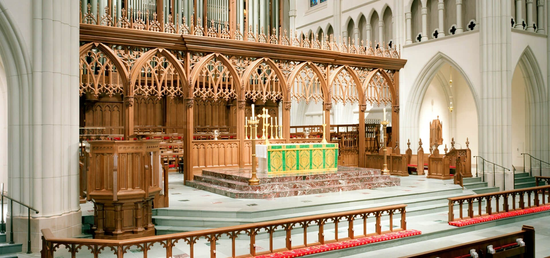
Worship spaces work the same way. Every element of your sanctuary, from the pews or seating to the platform furniture, from the reading table to the communion table, is telling visitors and members alike what your community values.
Does the seating suggest that comfort and long-term investment in your congregation’s experience matter? Or does it suggest that furniture decisions get put off until something breaks? Is the layout welcoming to people with limited mobility, or does it communicate that accessibility was an afterthought? These are not abstract questions. They play out in real time every time someone walks through your doors.
What Your Seating Says About Your Community
Seating is the dominant visual and physical element in most sanctuaries. It covers more floor space, draws more of the eye, and occupies more of a worshipper’s physical awareness than almost anything else in the room. That makes it one of the most powerful communicators of congregational values.
Comfort signals care. Pews or chairs that are thoughtfully upholstered, sized appropriately, and arranged to give people adequate space communicate that your congregation has considered the human beings who sit in them. Conversely, seating that was selected purely on cost, without regard for long-term comfort or durability, tends to communicate the same. People notice, even if they cannot articulate it.
Craftsmanship signals permanence and investment. There is a meaningful difference between seating that was built to last generations and seating that was built to a price point. Hardwood construction, quality upholstery, and careful joinery carry a visible weight and presence that communicates longevity. It says, in effect, “We plan to be here for a long time, and we invested accordingly.” That matters, especially to families evaluating whether a congregation is one they want to plant roots in.
Layout signals theology. This one is often overlooked, but it is deeply real. A sanctuary where curved pews draw the congregation into a gentle arc around a central focal point communicates something about community and shared worship that a long, narrow room with rows pointing toward a distant platform does not. The physical arrangement of seating reflects, intentionally or not, a congregation’s understanding of how worship happens and what the relationship between the gathered community and the space itself should feel like.
Platform Furniture and the Focal Point of the Room
Seating is not the only communicator in the room. The furniture at the front of the worship space, the reading table, the clergy seating, the communion table, the lectern or pulpit, all of it participates in the same conversation.
When these pieces are cohesive with the overall design of the sanctuary, the room feels unified and purposeful. When they have been collected piecemeal over the years, mismatched in wood tone, scale, and style, the room can feel unresolved, even to people who would not describe themselves as design-conscious.
For liturgical congregations in particular, platform furniture carries deep theological significance. The placement and design of the reading table, the altar, and the space for clergy movement are not just aesthetic choices. They reflect denominational tradition and the congregation’s understanding of worship.
The same principle applies in synagogues, where the bimah, the reading table, and the Torah ark work together to anchor the entire worship experience. When those elements are designed with intention and craftsmanship, the space communicates the reverence and seriousness with which the congregation approaches worship.
The Message Accessibility Sends
One of the most telling things a worship space can communicate is how it thinks about who belongs there.
Sanctuary layouts that make genuine, thoughtful space for wheelchair users, people with mobility aids, and those who need companion seating send a clear message: everyone is welcome here, and we thought about you when we designed this space. Layouts where accessibility feels like a compliance checkbox, where wheelchair spaces are tucked into corners or positioned where sightlines are poor, communicate something very different, even if that was never the intention.
Inclusive, ADA-compliant seating arrangements do more than meet code requirements. They participate in the congregation’s ongoing statement about hospitality and belonging. That is worth taking seriously when making seating decisions, not just as a legal consideration, but as a values conversation.
When the Furniture No Longer Fits the Congregation
Sometimes the disconnect between a congregation’s values and its physical space is not a result of poor decisions. It is simply the result of time. A sanctuary that was designed and furnished for a congregation of a certain size and demographic in 1975 may communicate something quite different to the congregation that occupies it today.
Pews that are worn and difficult to maintain, platform furniture that reflects a design aesthetic from several decades ago, seating that does not account for the range of physical needs in a congregation that has grown and aged, these things gradually create a gap between what the congregation believes about itself and what its space says about it.
This is one of the most common things building committees grapple with during renovation planning: not just “what do we need to replace,” but “what do we want our space to say going forward, and is it saying that now?” That is a genuinely worthwhile question, and it deserves more than a purely practical answer.
Intentionality Is the Real Message
Ultimately, what well-chosen, well-crafted sanctuary furniture communicates most clearly is intentionality. That someone cared. That the people who make decisions for this congregation thought carefully about the experience of worship, about the comfort and dignity of the people who gather here, and about the long-term stewardship of a space that belongs to the whole community.
That is not a message that requires a capital campaign or a complete renovation to send. It shows up in the quality of what was chosen, in how well it has been maintained, and in how thoughtfully it was designed to serve the congregation’s actual needs.
For building committees beginning to think about a sanctuary renovation or new build, the starting point is not always “what do we need?” Sometimes the better question is “what do we want our space to say?” The furniture answers that question whether you plan for it to or not. You might as well plan intentionally.