

If you’ve been bouncing between five different apps just to finish one design project, you already know the problem. DesignMode24 tools tech brings those scattered workflows into one connected environment — built for designers, planners, and homeowners who want professional results without the professional learning curve. This article breaks down what the platform actually does, where it earns its place, and what to realistically expect.
Key Takeaways
- DesignMode24 tools tech connects visualization, planning, and collaboration in one place — cutting the back-and-forth between separate apps.
- Real-time rendering lets you see material and lighting changes instantly, reducing costly revision cycles before anything gets built.
- Workflow structure is built in — version tracking, client comments, and role-based access are default features, not add-ons.
What DesignMode24 Tools Tech Actually Is
DesignMode24 tools tech is a connected ecosystem of digital design utilities that puts professional-grade visualization and project management inside a single, accessible platform. It’s built for people who need to make accurate design decisions faster — without hiring a full studio or learning enterprise-level software from scratch.
Not one app. A connected system where every tool shares the same design-first logic.
Here’s something I’ve noticed working around design tools for a while: most platforms are great at one thing and awkward at everything else. A rendering tool that can’t track revisions. A floor plan app that exports a PDF nobody can actually use. A collaboration tool that has no idea what a material finish is.
That fragmentation costs real time. A 2025 McKinsey Digital report found that design-adjacent professionals — architects, interior planners, brand managers — lose an average of 34% of their workweek to tasks that current tools could partially automate or streamline. That’s more than one full working day, every single week, gone.
DesignMode24 design addresses that gap not by adding more features, but by making the features that already exist talk to each other. When your floor plan, your materials library, your client feedback, and your export function all live in the same environment, the project moves differently. Decisions happen faster. Mistakes surface earlier. Revisions cost less.
DesignMode24 Interior Design Tools: Built for Real Spaces, Not Templates
The interior design side of the platform is where most US users find immediate value — and for a reason that’s worth understanding clearly.
A floor plan is difficult for most people to read. They see dimensions and lines and feel nothing emotionally. But show that same person a rendered room — their actual room, with real furniture proportions, real light coming through real window positions, real material on the floor — and suddenly they have strong opinions. Fast ones.
That gap between technical drawing and human understanding is exactly what designmode24 interior design tools are built to close. You input your actual dimensions. The tool builds your actual space. You’re not adjusting a generic template hoping it’s close enough — you’re working with your specific room from the first step.
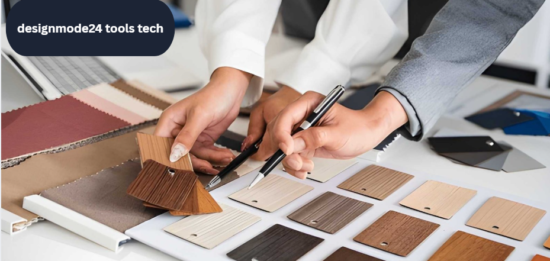
In my experience, this is where the platform separates itself from cheaper alternatives. The materials library isn’t a collection of generic swatches. It includes actual manufacturer finishes — tile patterns, fabric textures, flooring options you can physically order. What is delivered to your door should correspond with what you see on the screen.That alignment between digital preview and physical reality sounds basic, but it’s still surprisingly rare in design software at this price tier.
There’s also a spatial logic layer running underneath everything. The tool flags clearance violations automatically — a door that can’t swing open fully, a dining table too close to the wall to pull chairs back, a sofa blocking the natural traffic path through a room. I’ve seen homeowners catch exactly these mistakes before ordering anything, which is the entire point.
The True Test of Any Interior Design Platform
A 2025 Houzz consumer survey found that 58% of US homeowners who completed a major renovation reported at least one significant furniture or layout mistake they wished they’d identified earlier. Tools that surface those errors before a single purchase order is placed have direct, measurable financial value.
The transition from visualization into full project workflow is where design designmode24 shows its real depth. Visualization is the entry point. But version tracking, asset libraries, collaboration features, and structured export functions are what make it a working environment for actual projects — not just an impressive demo.
The honest test for any design platform is simple: can you finish a real project in it, start to finish, without exporting halfway through to fix something in another app? That’s the bar. A lot of platforms fail it. The ones that pass it are the ones worth building your workflow around.
The Workflow Side Nobody Writes About

Here’s an angle that doesn’t get enough attention in most DesignMode24 coverage: the design workflow around a project matters as much as the design itself.
You can have the best spatial instincts in the room. But if your files are named “final_v3_ACTUAL_FINAL_revised,” your client feedback is scattered across email threads, and your version history is a manual mess — the project suffers regardless of your talent.
DesignMode24 tools tech handles this with workflow structure built into the platform by default, not layered on as an afterthought. Projects are organized automatically. Versions track without you remembering to save separately. Client comments attach to specific elements inside the design — not floating in a separate document that nobody can match to the actual model.
That specificity changes the nature of revision conversations entirely. When a client says “I don’t like the kitchen,” you can ask them to mark exactly what they mean — and they can, directly on the model. Instead of decoding vague feedback and guessing, you’re working from precise, located input. Anyone who has managed a design project through email alone knows how much time disappears in that translation gap.
The collaboration structure also scales to teams. Role-based access means a client can view and comment but can’t accidentally delete a structural layer. A junior team member can develop details without touching the core design logic. That kind of access control is standard in software development environments but has historically been rare in design platforms. Its presence here is genuinely useful, not just a feature checkbox.
A 2024 Forrester Research report found that teams using integrated design and project management platforms completed projects an average of 23% faster than teams running separate tools for each function. The gain isn’t from any single tool being faster — it’s from the entire system being coherent.
Quick Reference: DesignMode24 Tools vs. Separate App Workflows
| Factor | DesignMode24 Integrated | Separate Apps |
| File organization | Automatic, project-based | Manual, user-dependent |
| Client feedback | Attached to design elements | Scattered across email/docs |
| Version tracking | Built-in, automatic | Manual saves, naming conventions |
| Material library | Manufacturer-accurate | Generic or disconnected |
| Revision speed | Faster — fewer miscomms | Slower — more translation gaps |
| Learning curve | Moderate upfront | Lower per app, higher overall |
Pro Tip — Start With a Real Project, Not a Practice One
This is something I’d tell anyone evaluating a new design platform: don’t create a fake test project to learn the tool. Use a real one — even a small one. A real deadline, real constraints, real client or personal outcome at stake. That pressure forces you to actually learn the platform rather than explore it casually and then revert to old habits. The learning curve on integrated tools is real, but it compresses fast when the stakes are genuine.
The platform won’t be perfect for everyone. If you’re a solo designer who works entirely in one specialized tool and has no collaboration needs, the integrated approach may be more than you need. But for US-based design professionals, interior planners, or homeowners managing a real renovation — the connected workflow pays back the learning investment quickly.
What to do next: Take one active project — something with real dimensions, a real deadline, real materials in consideration — and run it through DesignMode24 tools tech from start to finish. Don’t switch back to old tools halfway through. Assess at the end. That’s the only honest way to know whether it fits how you actually work.