

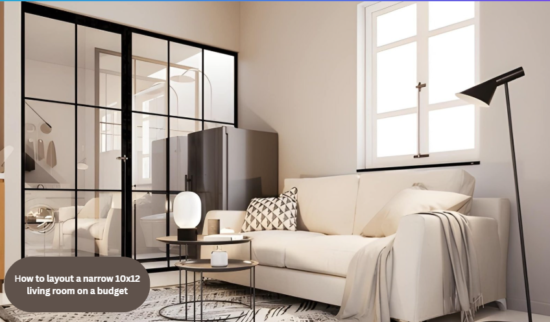
The answer to how to layout a narrow 10×12 living room on a budget is to put the sofa on the long wall, keep a 30–36 inch walkway, and choose a shallow coffee table. Test the plan with painter’s tape first, so you buy nothing that does not fit.
Key Takeaways
- A 10×12 room covers 120 square feet, and its 10-foot width sets every layout decision.
- Style by Emily Henderson recommends a 30 to 36 inch walkway between large pieces and accepts 18 to 24 inches only when the room allows nothing more.
- Venicasa advises a sofa about two-thirds the length of its wall, which is 96 inches on a 12-foot wall.
- Painter’s tape on the floor tests the whole plan before you spend a dollar.
- Reusing furniture you own and buying only a right-sized sofa and rug keeps costs down.
How to Layout a Narrow 10×12 Living Room on a Budget, Step by Step
Measure the room, tape each furniture footprint on the floor, and set the walkway before anything else. The rest of the room fits around that path.
The DesignMode24 method starts with the floor, not the furniture. A 10×12 room is 120 inches wide and 144 inches long.
For scale, the U.S. Census Bureau and the Department of Housing and Urban Development reported a median of 1,020 square feet for multifamily units completed in the third quarter of 2025. That figure covers newly built units only, not every apartment in the country.
- Measure every wall, window, door swing, and vent in inches.
- Cut paper or lay painter’s tape to match each piece’s footprint.
- Place the sofa first, on the 12-foot wall.
- Add the coffee table or side tables.
- Walk from the door to every seat, and widen any spot where you turn sideways.
Digital planning apps, a topic covered under designmode24 tools , work well as a second check once the tape layout feels right. More room plans sit at www.designmode24.
What does the math look like in a real 10×12 room?
A sofa, a gap, and a coffee table use 72 inches of the 120-inch width, which leaves 48 inches of open floor.
Take an 84-inch sofa that is 36 inches deep, a 16-inch gap, and a coffee table 20 inches deep. Those add up to 72 inches (36 + 16 + 20). Subtract that from the 120-inch width and 48 inches remain to the opposite wall.
That clears the walkway rule from Style by Emily Henderson by 12 to 18 inches. A console 12 inches deep on the far wall still leaves 36 inches.
The sofa, gap, table, and console sizes are example values. Swap in your own measurements.
Where Should the Sofa Go in a Narrow Living Room?
Put the sofa against the 12-foot wall. That placement lets the 10-foot width hold the sofa, the table, and a walkway together.
A designmode24 interior plan for a narrow room starts here, because the sofa is the largest piece and fixes the rest.
Floating the sofa on the 10-foot wall leaves more open floor but points the seating down a long, tunnel-like room. Choose it only when a door or window blocks the long wall.
What sofa size fits a 10×12 living room?
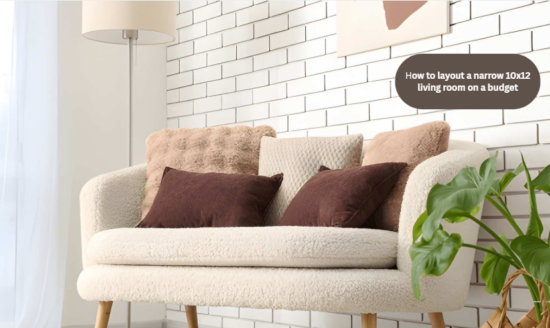
Choose a sofa about two-thirds the length of its wall, which is 96 inches on the 12-foot wall, according to Venicasa. The same guide says a loveseat or apartment sofa under 72 inches protects flow in small rooms.
The two figures measure different things. The 96 inches is a ceiling from a proportion rule, and 72 inches is the safer pick when the room also holds a console or desk. The 84-inch sofa in the example above sits between them.
Which layout leaves the most walking space?
Layout A, with the sofa on the long wall and a coffee table, gives the best balance. Layout C gives the widest walkway by trading the coffee table for side tables.
| Layout | Floor used | Open floor left | Best when |
| A: Sofa on 12-ft wall, coffee table | 72 in of the 120-in width | 48 in | The room needs one central surface |
| B: Sofa on 10-ft wall, coffee table | 72 in of the 144-in length | 72 in | The long wall holds the door or windows |
| C: Sofa on 12-ft wall, two side tables | 36 in of the 120-in width | 84 in | The walkway is the priority |
Floor-used figures assume a 36-inch-deep sofa, a 16-inch gap, and a 20-inch-deep table. Open floor is the room dimension minus the floor used.
How Big Should a Coffee Table Be in a Small Living Room?
Make the table at least half the length of the sofa, and keep its height within 4 inches of the seat cushions, according to Style by Emily Henderson. For an 84-inch sofa, Flowyline’s guide puts the table at 42 to 56 inches long.
The distance between the table and the sofa should be 16 to 18 inches. Flowyline allows as little as 14 inches, while Style by Emily Henderson calls 16 to 18 inches ideal, so 16 is a safe middle.
Depth matters most in a narrow room. Flowyline lists 18 to 24 inches as the typical width of a coffee table, and here every extra inch comes straight out of the walkway. Choose 18 to 20 inches.
Flowyline also sets 24 inches of clearance around a coffee table as the minimum for passing. That is a comfort floor for one table, while Henderson’s 18 to 24 inches is a last-resort width for walkways between large pieces. Check both numbers against your tape layout.
What Can You Reuse and Buy to Furnish a Narrow Living Room Cheaply?
Reuse whatever fits the tape layout, and spend only on a right-sized sofa and rug. Everything else can be secondhand or already in your home.
These small living room cost little and respect the floor plan:
- Keep side tables, lamps, and shelves that pass the tape test.
- Hang a mirror across from the window to bounce daylight deeper into the room.
- Use wall shelves and tall bookcases so storage takes height, not floor.
- Swap a bulky coffee table for nesting tables or an ottoman with a tray.
- Pick a sofa with raised legs and slim arms, which shows more floor.
When you work out how to decorate a small living room, limit the palette to one wall color, one rug, and two or three accents. Fewer competing colors keep a long, narrow shape calm.
Renters get the most from apartment living room decor that move with them, such as lamps, mirrors, rugs, and freestanding shelves. A sound interior design habit is to make every piece earn its floor space.
What Is the Most Common Mistake in a Narrow Living Room Layout?
Buying deep furniture before measuring the width is the most common mistake. Showroom floors are large, so a 40-inch-deep sofa looks small there and then crowds a 10-foot-wide room at home.
Here is the math. A 40-inch-deep sofa, an 18-inch gap, and a 30-inch-deep table use 88 inches of the 120-inch width. That leaves 32 inches, and a 12-inch console on the far wall cuts it to 20 inches, which falls inside Henderson’s 18 to 24 inch last-resort range but under her 30 to 36 inch recommendation.
The fix takes three steps:
- Choose a sofa no deeper than 36 inches.
- Choose a coffee table no deeper than 20 inches.
- Tape both footprints and walk the room before buying.
Browse room layout ideas only after you have your measurements, because photos hide a room’s true width. Under the designmode24 design approach, the tape test comes before any purchase. Readers with an unusual floor plan can send details through designmode24 com.
When does the usual advice not apply

Rooms that serve as the main route to a bedroom or balcony need the full 30 to 36 inches. A room with one door and one seating group can run at Henderson’s 18 to 24 inch minimum.
Hosting changes the math as well. For a game-day crowd, such as a super bowl biggest sporting event watch party, push the coffee table aside and use floor cushions instead of extra chairs.
FAQ
What is the best furniture layout for a narrow living room?
Put the sofa on the long wall and keep a 30 to 36 inch walkway in front of it.
That arrangement uses the room’s width for seating and leaves the length open for movement. Add a shallow coffee table or two side tables, and keep tall pieces against the walls.
How much walkway space does a 10×12 living room need?
Plan for 30 to 36 inches between large pieces, and accept 18 to 24 inches only when the room leaves no choice.
Style by Emily Henderson gives both numbers. Use the larger range if the room is also a route to another space.
Can a 10×12 living room fit a sectional?
Only a compact sectional fits, and it must leave the 30 to 36 inch walkway clear.
Homestyler notes that small sectionals under about 100 inches wide can work when the walkway is preserved. Tape the L-shaped footprint first, because the chaise end uses more floor than a straight sofa.
How far should a coffee table sit from the sofa?
Keep 16 to 18 inches between the sofa and the coffee table.
That gap gives legroom and keeps drinks within reach. Flowyline allows 14 inches in tight rooms, which is the lowest figure in the sources reviewed here.
How do you test a layout before buying furniture?
Mark each piece’s footprint on the floor with painter’s tape, then walk the room.
Cardboard cut to the size of each piece adds a feel for height and bulk. If you turn sideways anywhere on the route from the door, shrink or move a piece.
Should you choose a loveseat for a small living room?
Choose a loveseat when a full sofa pushes the walkway below 30 inches.
Venicasa says an apartment sofa under 72 inches protects flow in small rooms. Measure the doorways and hallway turns before ordering, since the delivery path matters as much as the room.
Conclusion
Knowing how to layout a narrow 10×12 living room on a budget comes down to three numbers: a 30 to 36 inch walkway, a sofa near two-thirds of its wall, and a 16 to 18 inch gap to the coffee table. Tape the plan, run the math, and buy only what fits.
F